
The CDC Just Released Interim Andes Virus Guidance.
Here’s what it actually says and what it doesn’t.

Over the last several days, social media has turned Andes virus (a type of hantavirus) into the latest “this could be the next COVID” panic cycle. Screenshots, speculation, and half-true statements are spreading faster than the facts themselves.
Now, we finally have something more concrete: interim CDC guidance related to the ongoing Andes virus investigation connected to passengers aboard the M/V Hondius cruise ship.
After reading the entire document, here’s the key takeaway: This is a serious public health investigation, but it is not evidence of an impending global pandemic. What the CDC released is essentially a detailed containment and monitoring playbook for a rare virus with limited but documented person-to-person transmission.
That nuance matters.
First: What Is Andes Virus?
Andes virus is a type of hantavirus found primarily in South America. Unlike the hantaviruses more commonly seen in the United States, Andes virus is notable because it can spread person-to-person under certain circumstances.
That’s why public health authorities are taking this outbreak seriously.
However, “can spread person-to-person” does NOT automatically mean “spreads easily.”
Those are very different concepts.
The CDC guidance repeatedly frames transmission around:
prolonged close contact,
shared living spaces,
bodily fluids,
caregiving exposure,
and extended indoor interactions.
This is not behaving like SARS-CoV-2, measles, or influenza. If Andes virus was, then I would be much more concerned.
Why the Cruise Ship Situation Triggered Alarm
The guidance focuses heavily on passengers aboard the M/V Hondius because cruise ships create an environment where:
people share enclosed spaces,
exposures are difficult to reconstruct,
and prolonged interactions are common.
The CDC therefore classified anyone aboard during a specific exposure window as “high-risk contacts.” That classification sounds dramatic online, but from a public health standpoint, it’s actually fairly logical. When authorities don’t yet know exactly who had close exposure, they cast a wider net early. That’s precautionary, not proof the virus is spreading uncontrollably.
The Internet Is Misreading the “42-Day Monitoring” Window
One thing fueling fear online is the CDC’s recommendation for 42 days of monitoring after exposure.
People see “42 days” and assume:
“This must be incredibly contagious or catastrophic.”
Not necessarily. The CDC lists the incubation period as ranging from 4 to 42 days, with a median of 18 days. Public health agencies generally monitor for the outer bounds of incubation periods when they want to avoid missing cases.
That’s not unusual.
For comparison:
rabies monitoring can extend for months,
tuberculosis investigations can span weeks to months,
and Ebola monitoring historically lasted 21 days.
Long monitoring periods are often about caution and surveillance, not transmissibility.
The Exposure List Tells Us Something Important
One of the most revealing parts of the guidance is the actual exposure questionnaire.
The CDC asks about:
kissing or hugging,
sharing a bed,
sexual contact,
sharing utensils,
sharing drinks,
exposure to saliva or respiratory secretions,
caring for sick individuals,
and spending prolonged time within 6 feet in enclosed spaces.
That list matters because it gives us clues about the kinds of interactions considered most concerning.
This is not:
“Someone walked past me in a grocery store.”
This is much closer to:
“Close, prolonged, intimate, or caregiving exposure.”
Again, important distinction.
Why the CDC Is Recommending Masks and Travel Restrictions
The guidance advises high-risk contacts to:
avoid commercial air travel,
minimize activities outside the home,
avoid crowded events,
wear masks indoors around others,
and avoid sharing personal items.
Some people online are interpreting this as proof authorities believe widespread airborne transmission is occurring. However, infection control guidance is often intentionally conservative early in an investigation, especially when dealing with a rare pathogen where data is still evolving.
Public health agencies would rather temporarily overestimate risk than underestimate it.
That’s especially true when:
the disease can be severe,
transmission dynamics are incompletely understood,
and the number of total known cases remains small.
The Most Important Thing Missing From the Panic Narratives
What’s not in the CDC document may actually be more important than what is.
There is:
no evidence of sustained community transmission,
no evidence of easy casual spread,
no indication of explosive exponential growth,
and no indication this virus suddenly mutated into something fundamentally different.
The guidance is structured around containment and monitoring, not mass mitigation measures for the general public. That distinction is critical. If this were behaving like an easily transmissible respiratory virus, the recommendations and tone would look very different.
Public Health Is Trying to Avoid Two Mistakes at Once
Right now, public health officials are balancing two competing risks:
Risk #1:
Underreacting to a potentially dangerous outbreak.
Risk #2:
Triggering unnecessary panic through overinterpretation.
Unfortunately, social media tends to amplify only the most emotionally charged interpretation possible.
That’s why you’re seeing:
“They’re hiding the truth!”
“This is airborne Ebola!”
“This is the next COVID!”
“Governments are preparing for lockdown!”
None of those claims are supported by the actual CDC guidance document.
What About the “Weakly Positive” PCR Case?
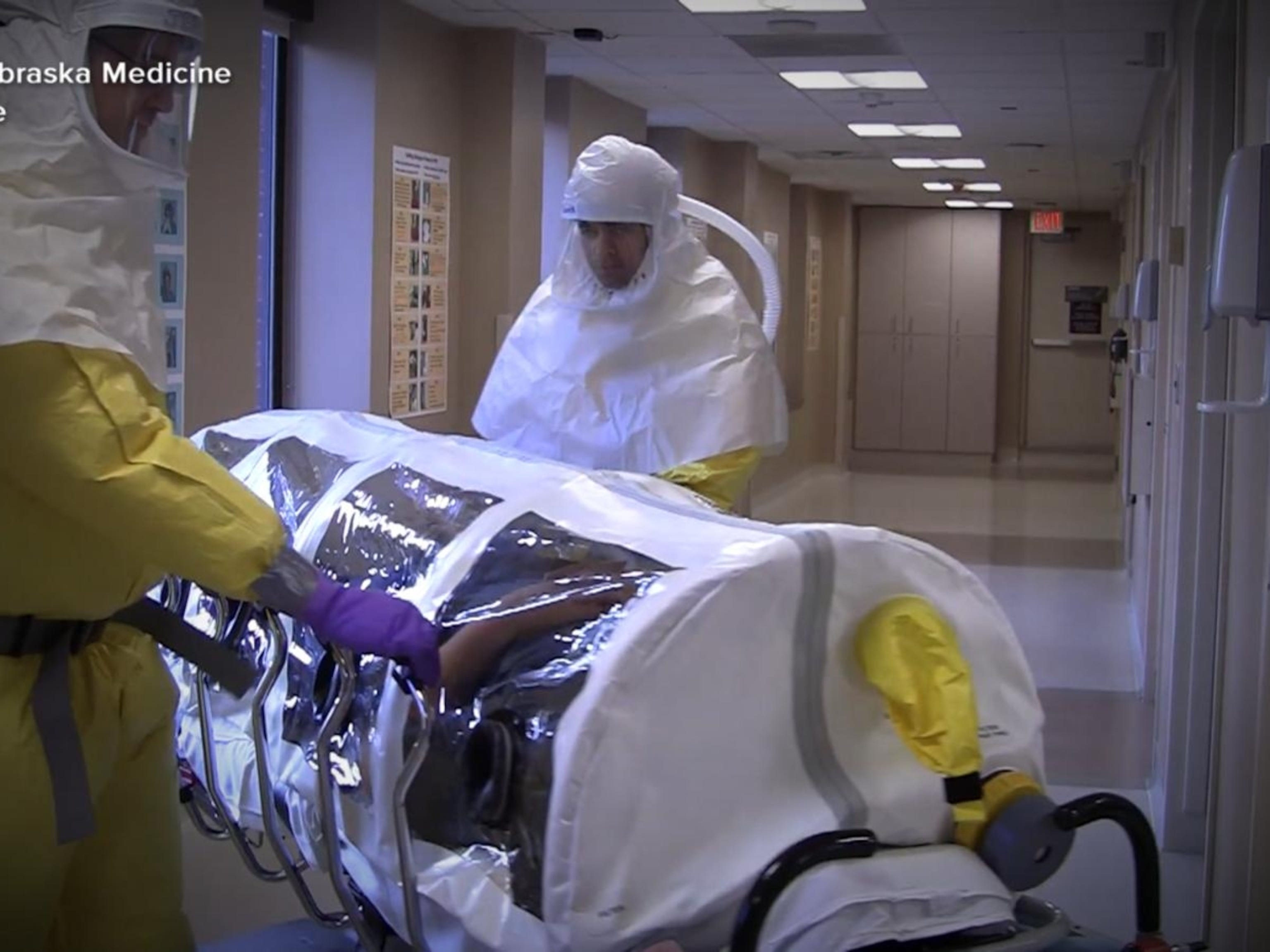
The Department of Health and Human Services recently announced that one of the American passengers going to Nebraska has a “weakly positive” PCR test for Andes virus.
PCR tests detect viral genetic material. A “weakly positive” result generally means a low amount of detectable viral RNA was found, but that does not mean the result is automatically meaningless or “fake.”
A low-level PCR positivity can happen for several reasons, including:
someone may be very early in infection,
someone may be later in infection,
the sample quality may vary,
or the viral burden may simply be low at that moment.
Importantly, public health officials are clearly treating this as a real positive requiring monitoring, not as a laboratory error.
According to reporting from Nebraska Medicine and multiple news outlets, the PCR-positive passenger is currently reported to be asymptomatic. Another passenger is reported to have mild symptoms but has not necessarily tested positive at this time.
That distinction matters.
A positive PCR does NOT automatically mean:
severe disease,
imminent deterioration,
or high contagiousness.
In fact, finding a case before severe illness develops is exactly what active monitoring systems are designed to do.
Why Some People Are Going to Nebraska While Others May Quarantine at Home
The CDC specifically states that high-risk contacts may choose:
home-based monitoring with modified activities,
orfacility-based management at the National Quarantine Unit in Nebraska.
That’s an important detail because it tells us officials are not treating this like a virus that spreads easily through casual public contact. If they believed casual exposure in everyday settings posed major transmission risk, home isolation would likely not even be an option.
Instead, health departments are instructed to evaluate:
whether someone can realistically follow isolation guidance,
whether they have an appropriate home setup,
and whether they can safely separate from others if symptoms develop.
The CDC isn’t relying on blind trust alone. There are monitoring systems, daily check-ins, travel restrictions, and risk assessments, and the transmission patterns we know about still point toward close, prolonged exposure, not casual spread in the grocery store.
The Nebraska unit exists partly because some individuals:
may not have an ideal home environment,
may prefer closer medical supervision,
or may want rapid access to specialized care if symptoms develop.
That’s very different from evidence of uncontrolled community spread. In many ways, this is exactly what a cautious but proportionate public health response looks like:
identify high-risk exposures, monitor carefully, provide layered containment options, and escalate care only when needed.
What People Should Actually Do
For the overwhelming majority of people reading this:
your personal risk remains very low
there is no recommendation for widespread behavior changes
and there is no evidence supporting panic buying, avoiding travel broadly, or assuming a pandemic is imminent.
But there is value in:
following updates from credible public health sources
understanding how transmission actually occurs
and resisting the urge to treat every emerging infection as an apocalyptic event.
Because fear spreads faster than viruses ever could, and in 2026, that may be the most contagious thing of all.
Although not required, any support is greatly appreciated, including supporting my new book.
Love an educated and leveled response. It seems uncommon rn. Thank you for this article.
I would NOT call the CDC credible in any sense!! Not under this administration.