
Why NIH Director Jay Bhattacharya’s Vaccine-Autism Answer Matters
Why His Word Choice Was Strategic

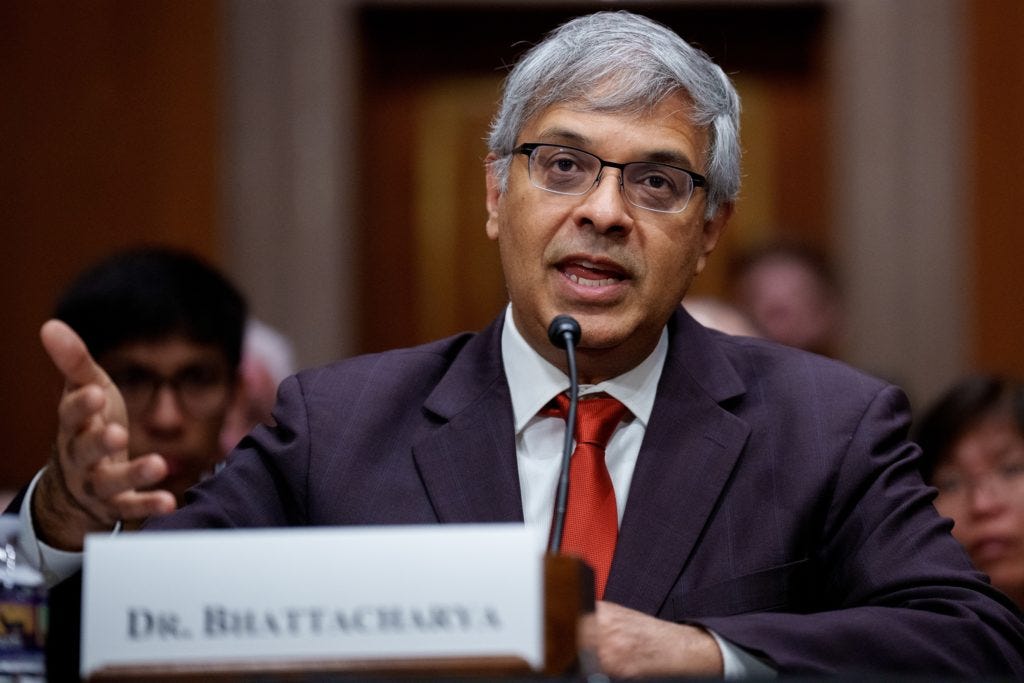
The Senate HELP Committee’s recent hearing produced a moment that deserves far more scrutiny than it’s received. Under questioning about vaccines and autism, Jay Bhattacharya, the director of the National Institutes of Health, was asked a direct yes-or-no question: Do vaccines cause autism? His response was telling. “I have not seen a study that suggests any single vaccine causes autism.” The answer sounded reassuring at first glance. However, the wording matters, and in this case, it matters a great deal.
The scientific consensus on this question is not ambiguous. Vaccines do not cause autism. This conclusion is not based on a single study or one vaccine product, but on decades of epidemiologic research involving millions of children, examining individual vaccines, combined schedules, and vaccine components. Major medical organizations and global public health bodies have repeatedly reviewed the evidence and reached the same conclusion. There is no credible causal link between vaccination and autism spectrum disorder. When a senior federal science official answers a direct question about that reality with careful narrowing language, it’s reasonable to ask why.
The phrase “any single vaccine” does significant rhetorical work. It allows the speaker to technically align with the evidence while leaving open the implication that something else such as combinations, schedules, cumulative exposure, or unidentified mechanisms might still be responsible. Those hypotheses are not new. They have been studied extensively, and they have failed to demonstrate a causal relationship. By restricting his answer to “any single vaccine,” Bhattacharya avoided stating the broader conclusion that the evidence actually supports. That’s not scientific precision; it’s hedging.
This matters because the question was not academic. It came in the context of a broader discussion about declining public trust in medicine and public health institutions. Bhattacharya cited survey data showing that trust in physicians has fallen sharply since the start of the COVID-19 pandemic, dropping to roughly 40 percent by early 2024. That decline is real, but the existence of mistrust does not validate the claims driving it. If anything, the data show that distrust correlates with poorer health outcomes and lower vaccine uptake. Rebuilding trust requires clarity, not carefully constructed ambiguity.
The political context makes the hedging even more consequential. Bhattacharya now serves under an administration in which Robert F Kennedy Jr, the Secretary of Health and Human Services, has repeatedly questioned vaccine safety and suggested links to autism, despite the lack of evidence. Recent controversies surrounding federal health agency messaging including softened or altered language about vaccines and autism have further confused the public. Against that backdrop, the NIH director’s words carry enormous weight. When the nation’s top biomedical research official does not plainly affirm a settled scientific conclusion, it leaves room for doubt where none is warranted.
It’s important to be precise here. Bhattacharya did not endorse the claim that vaccines cause autism. He did not cite discredited studies or repeat outright falsehoods. However, public health communication is not graded on technical plausibility alone. It is judged by what people hear and how messages land in a climate already saturated with misinformation. In that environment, refusing to say “vaccines do not cause autism” is not a neutral act. It reinforces uncertainty, even if unintentionally.
If restoring trust in medicine is truly the goal, then leaders must be willing to state plainly what the evidence shows, even when that clarity is politically inconvenient. Autism is real. Adverse Vaccine reactions are possible, but a causal link between vaccines and autism is not. Conflating uncertainty about trust with uncertainty about evidence only deepens the very mistrust officials claim to be concerned about.
The takeaway from that exchange isn’t that science is unclear or evolving on this question. It’s that political caution is now shaping how scientific truths are voiced, and when that happens, the public doesn’t hear nuance, people hear doubt.
Dr. Battacharya, through his misinformed denial of the seriousness of COVID and the effectiveness and safety of vaccines, is in large part responsible for the loss of confidence in science and medicine in the general population.
We expect weasel-words from politicians, but not doctors. Shame on him!