
Why This ACIP Interview Should Alarm Every Parent and Clinician
How the ACIP Chair’s Own Words Undermine Vaccine Science, Safety, and Public Trust

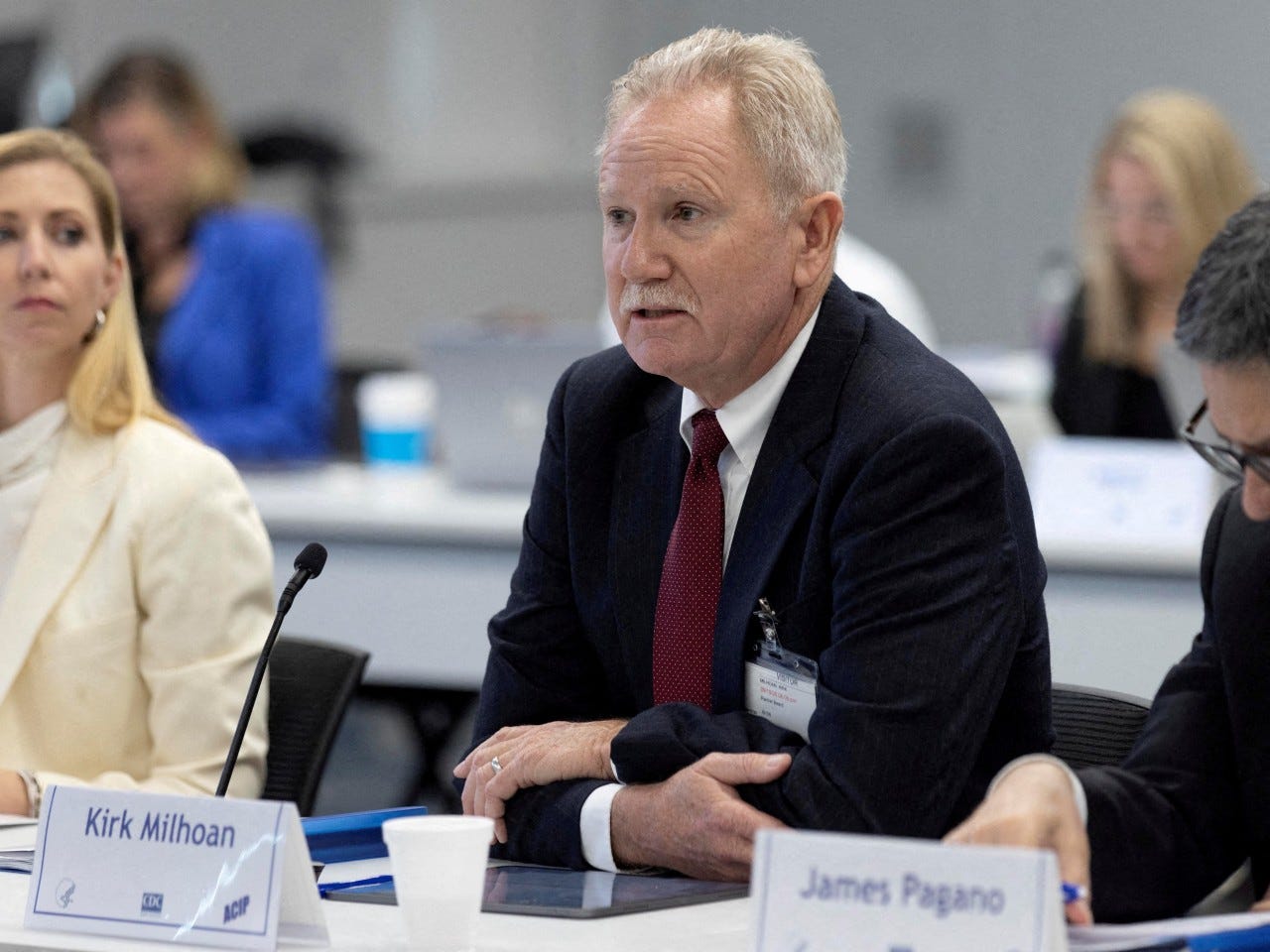
When the chair of the Advisory Committee on Immunization Practices (ACIP) speaks, the stakes are enormous. ACIP recommendations don’t just shape clinical guidance; they shape trust, vaccine uptake, school policies, and ultimately whether preventable diseases return. That is why the recent podcast interview with Dr. Kirk Milhoan, the current chair of ACIP who is a pediatric cardiologist, should deeply concern anyone who cares about children’s health.
This concern is not about politics, ideology, or personal faith. It is about method, evidence, and rhetoric. Throughout the interview, Dr. Milhoan repeatedly undermines foundational principles of medical science, reframes risk in misleading ways, and casts doubt on the safety and value of routine childhood vaccines using language that departs sharply from established evidence. When these claims come from someone in his position, the downstream consequences are real.
Redefining science in a way that abandons rigor
One of the most revealing moments in the interview comes when Dr. Milhoan is challenged on whether he is relying on established scientific evidence or personal impressions. His response is stark:
“But that’s not science. Science is what I observe.”
This statement is not a semantic quibble; it represents a fundamental misunderstanding of how biomedical science works. Observation is the starting point of science, not its conclusion. Modern medicine depends on systematic data collection, controlled trials, replication, population-level inference, and methods explicitly designed to reduce individual bias. Elevating personal observation to the level of scientific authority is precisely why evidence-based frameworks exist, which is to protect patients from the limitations of individual experience.
Equally concerning is his rejection of the concept of scientific proof:
“When people use the word ‘proven,’ it’s a contradiction to the word science.”
This rhetorical move is common in misinformation spaces. Science does not claim absolute certainty; it relies on converging evidence, consistency across populations, biological plausibility, and reproducibility. Vaccines like MMR are not “proven” in a philosophical sense; they are supported by decades of high-quality epidemiologic, clinical, and real-world data. Rejecting the word “proven” becomes a way to suggest perpetual uncertainty even where consensus is overwhelming.
Calling vaccine safety an “emotional” concept
Perhaps the most destabilizing claim in the interview is Dr. Milhoan’s insistence that safety is not a scientific concept at all:
“I don’t like the word safety. Safety is not a scientific word. Safety is an emotional response to risk.”
In medicine, safety is a rigorously quantified concept. It is measured through adverse-event rates, severity classification, confidence intervals, post-marketing surveillance, and comparative risk assessment. Calling safety “emotional” reframes empirically measured risk as subjective fear, subtly delegitimizing the massive body of vaccine safety science that already exists.
This framing allows Dr. Milhoan to later assert without evidence that vaccines have largely escaped proper safety scrutiny:
“No, they haven’t been [appropriately studied for safety]. They’ve been mostly studied for efficacy.”
This statement is simply false. Vaccine safety evaluation occurs before licensure and continues for years afterward through multiple independent systems, including passive signal detection and active surveillance. One can reasonably argue about the strengths or limitations of specific systems but claiming that vaccines are mostly not studied for safety misrepresents decades of work and invites unwarranted fear.
Downplaying measles by anchoring it to the past
Measles serves as a litmus test for whether someone understands the difference between historical context and current biological reality. Dr. Milhoan repeatedly frames measles as a disease whose risks largely belonged to an earlier era:
“Many of those risks… were in the 1960s. We take care of children much differently now.”
This argument is misleading. Better supportive care reduces mortality, but it does not eliminate the risk of severe complications like pneumonia, encephalitis, or death. Measles remains a highly contagious airborne virus, and modern outbreaks repeatedly demonstrate that it causes serious harm in unvaccinated populations today, not just in historical archives. The ongoing measles outbreak in the United States that started in January 2025 has resulted in ongoing transmission and 3 deaths (2 children and 1 adult). There was an additional measles death in a child who was infected years earlier and developed subacute sclerosing panencephalitis (SSPE), a devastating neurodegenerative disease.
When pressed directly on whether vaccination is the best way to prevent measles, Dr. Milhoan offers a notably qualified response:
“I think it’s very helpful… pretty damn close.”
For the chair of ACIP, hesitation on this point matters. The evidence supporting measles vaccination as the most effective prevention strategy is among the strongest in all of infectious disease medicine. Public ambivalence from leadership erodes clarity precisely when outbreaks are resurging.
Inflating vaccine risk while minimizing disease risk
Throughout the interview, Dr. Milhoan repeatedly emphasizes rare vaccine adverse events while downplaying or relativizing the harms of disease. This imbalance is subtle but powerful. At one point, he frames vaccine injury and disease harm as morally equivalent scenarios:
“There could be unintended harm if we give it, and unintended harm if we don’t.”
While technically true, this framing collapses proportionality. Medicine is not about whether risk exists, it is about how much risk exists and compared to what. By that logic, we would treat the rare risk of an allergic reaction to antibiotics as equivalent to the risk of untreated bacterial sepsis. Vaccines are recommended because the risk of serious adverse events is orders of magnitude lower than the risk of harm from the diseases they prevent. Presenting these risks as roughly symmetrical misleads parents who lack the tools to contextualize epidemiologic scale.
Unsupported claims about outbreaks and vaccination failure
One particularly alarming moment comes when Dr. Milhoan asserts:
“We have a major pertussis outbreak in Texas and 100 percent of the people who got pertussis were vaccinated.”
This claim has not been substantiated by publicly available surveillance data and contradicts how pertussis epidemiology is typically reported. Even when outbreaks occur in highly vaccinated communities, that does not imply vaccine failure; it reflects waning immunity, incomplete coverage, or clustering among under vaccinated groups. Even so, vaccinating against pertussis also decreases the risk of serious disease. Statements like this, delivered without evidence, risk convincing the public that vaccines are ineffective when the reality is more nuanced.
Elevating autonomy while sidelining public health
Dr. Milhoan repeatedly states that ACIP is shifting its orientation:
“We are returning individual autonomy to the first order. Not public health.”
This is a profound redefinition of ACIP’s mission. ACIP has always considered individual risk while offering population-level guidance designed to protect communities, especially those who cannot be vaccinated due to medical conditions. Framing public health as secondary reframes collective protection as coercive rather than ethical.
His opposition to school vaccine requirements follows naturally from this view:
“Do we need to mandate these vaccines to go to kindergarten? I don’t think so.”
This position ignores the historical role school-based requirements have played in preventing outbreaks and protecting vulnerable children. Mandates are not about forcing uniformity; they are about preventing predictable harm when voluntary uptake falls below protective thresholds.
The danger is not his personal doubt—it’s his platform
Dr. Milhoan frequently emphasizes humility and openness to being wrong. That posture, by itself, is admirable. The problem is not uncertainty; the problem is where that uncertainty is expressed and how it is framed. When the chair of ACIP publicly suggests that vaccine safety is poorly understood, that measles risks are largely historical, and that scientific consensus is merely institutional bias, parents do not hear nuance, they hear permission to delay, refuse, or distrust.
The most troubling aspect of the interview is not any single claim. It is the cumulative effect: redefining science, recasting safety as emotion, inflating rare risks, and weakening clear endorsements of routine vaccines, all while occupying a position designed to stabilize trust.
Parents deserve transparent information. Clinicians deserve guidance grounded in evidence. Children deserve protection from diseases we already know how to prevent. Leadership that equivocates on these fundamentals does not merely invite debate; it invites resurgence of harm we have spent generations working to prevent.
This interview should not be ignored. It should be examined carefully, quoted accurately, and responded to clearly because when trust erodes at the top, the fallout is measured not in headlines, but in hospitalizations, outbreaks, and lives that never needed to be lost.
This administration seems to be genuinely placing the absolute worst candidate possible for any given position. My God. If my kids’ doctor started talking like Mr. Milhoan, I’d be looking for a new one the same day and filing a complaint.
I am a pediatric cardiologist like Milhoan and apologize on behalf of our people, we are not all this bad at general medicine. He has left the normal guardrails of pediatric medicine and is a propagandist now using words that sound reasonable to the uninitiated but deeply mistaken for all the reasons Dr Rubin shared above.